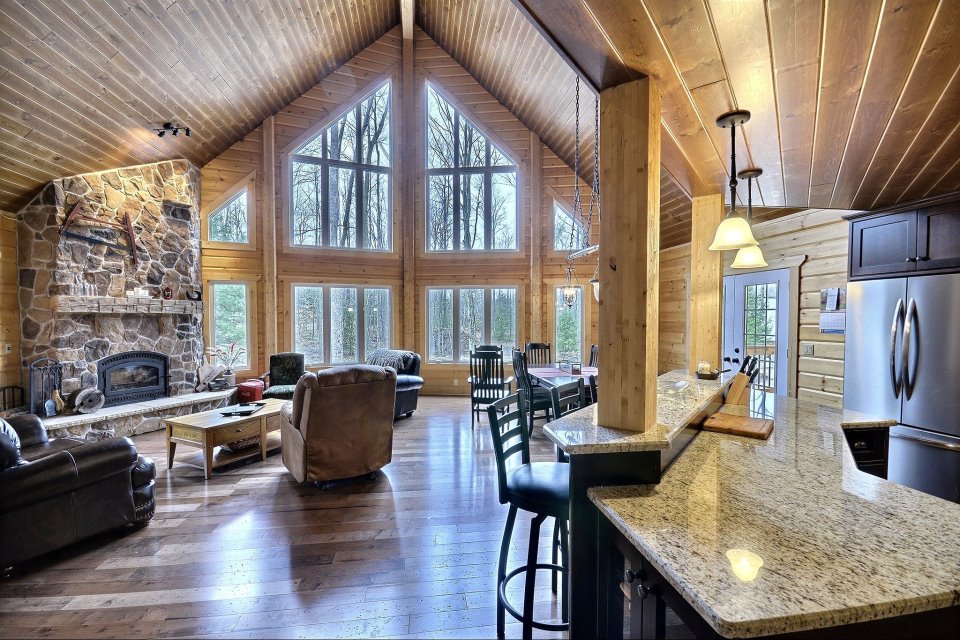
 My husband and I have always dreamed of owning and living in a log home. The atmosphere of a log is almost in-describable. A log home should be welcoming, comfortable, cozy, and fit your personality. We were very close to finalizing a package from a log home company several years back. We had the plans drawn and were going through the red line process. Then the economy started to go down, my employer of 20 plus years conducted another Reduction In Force and I was offered a position is Texas.
I have nothing against Texas, I just love living where I live and did not want to move. Also, my aging mom lived with us and it was not the right time in her life to relocate several hundred miles away. Going from a 6 figure income to a low 5 figure took some adjusting and the log home got put on hold.
We have pulled out the plans and dusted them off. Since designing the first set of plans, Mom has passed and we no longer have the needs we had then. We are looking at other options and focusing more on energy efficiency. My sister-in-law is well versed in sustainability and green-stuff. We rely on her expertise to lead us in the right direction. She and her husband are also building and we want to build at the same time. We have worked so closely, she knows what we want in a house, and we know what they want.
The scary part of the process is deciding on the log package. Each site and representative easily tells you their product is the best and the most cost efficient. Their logs are processed in the best possible procedure to give you the best end result…. It is good that they feel this way about their product, but to the consumer, it is very difficult to cull the things out that are important to their needs and dreams.
A big buzz word right now is GREEN BUILDING and every company is pulling the phrase into their marketing material and websites. And when you ask if their product can provide an Energy Star rating, some come out and say we can give you wider logs to give you more points, or they immediately focus on a component of their home which has an Energy Star rating, but this does not actually answer the question. Below is an exerpt from a guide supplied by the NAHB, (http://www.nahbgreen.org)
The home building industry coined the phrase green building in the late 1980s, turning a niche movement of resource-efficient homes into a quiet revolution – one that is increasingly becoming a preferred way to build and remodel.
Whether you’re a home building professional looking to go green or a prospective green homebuyer, the reasons for going green are numerous.
Green building means incorporating environmental considerations and resource efficiency into every step of the home building and land development process to minimize environmental impact. It’s a practical response to a variety of issues that affect all of us – like increasing energy prices, waning water resources, and changing weather patterns. It means making intentional decisions about:
- Energy efficiency improvements such as high levels of insulation, efficient HVAC systems, high-performance windows and energy-efficient appliances and lighting
- Water conservation measures such as water-efficient appliances and fixtures, filtration systems, and drought resistant or low-maintenance landscaping
- Resource conservation using materials and techniques such as engineered wood and wood alternatives, recycled building materials, sustainably harvested lumber, and more durable products
- Indoor environmental quality considerations such as effective HVAC equipment, formaldehyde-free finishes, low-allergen materials, and products with minimum off-gassing or low volatile organic compounds (VOCs)
- Site design planning such as minimizing disruption and preserving open space
- Homeowner education through manuals and operating guides
- Green business practices that adopt ideas from other industries for saving resources and money in the home office
The first official green home building program began in 1991 in the city of Austin, Texas. The movement has grown slowly but surely since then and today, new homes are significantly more energy and resource efficient than they were even 20 years ago. A past survey of NAHB members showed that more than two-thirds are incorporating at least some of these green features into the homes they build — and that as the home building industry begins to revive, it will be significantly greener. With the 2009 ANSI approval of the ICC 700 National Green Building Standard, builders, remodelers, and homebuyers now have a clear definition of green residential construction and a crediblecertification to that standard by a qualified third party.
I think we consumers need a check list where we can ask the same questions of all the suppliers we are interested in and compare apples to apples. The check list could be created by a third party, so as not to favor a specific supplier/builder.
We recently met with a local green builder and he asked some very interesting questions. The first is, what is the consumer looking for when they say Green? Do they want an energy efficient home, do they want a LEED certified home, or do they want to be off the grid? He provided a great informational sheet that explains the different levels of Green Building, the estimated cost associated with each level, and building techniques involved. Wouldn’t it be wonderful to approach a log home distributor and be able to ask what level their model meets, and what the associated costs would be. Appliances now provide an energy efficiency rating, I wonder if the building trade will ever advance to that level. ( I actually heard California will soon be requiring a rating something like this on all new construction.)
All in all, the responsibility still falls on the consumer to do our homework. Know what we are asking for, and know what questions to ask to get the answers we need. The looking at the models, magazines, and brochures was the fun part, the dreaming was the fun part, the final supplier selection is very fearful. Stay tuned as we move through the process of selecting a package and building our dream home.


 It's Your Time To Sparkle
Leave a reply to Home Renewable Energy Cancel reply